
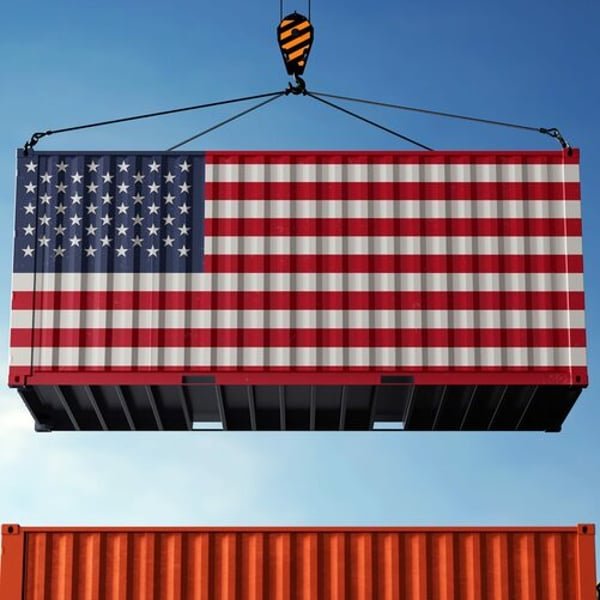
The United States boosted its textile-clothing imports by 9.4% in the first quarter (January-March 2025). This increase is explained by the then uncertain prospect of new customs taxes, which Donald Trump finally announced on April 2. This acceleration mainly benefited Asian suppliers, up 15.4%, to the detriment of China, Latin America, and the European Union.

Over the first three months of the year, the United States imported $26.9 billion worth of goods, including $20 billion worth of clothing (+10.9%) and $6.9 billion worth of textiles and materials (+4.9%). However, the countries most targeted by Donald Trump at the beginning of the year did not benefit from this last-minute acceleration, with principals likely anticipating the trade war promised by the Republican president.
China is one of the countries not to benefit from this early-year acceleration. As the leading supplier of textiles and clothing to the United States, China’s sales rose by just 3.6% over the period. At a time when other key Asian suppliers have seen significant increases. These include Vietnam (+14%), India (+20%), Bangladesh (+25%), Indonesia (+20%), Cambodia (+15.8%), and Pakistan (+10.5%).
The European Union, the USA’s sixth-largest supplier, remained stable in terms of textile-clothing exports to the USA, with 1.3 billion euros worth of goods shipped over the quarter. Italy, which alone ranks tenth among suppliers, even saw a contraction of 2.7%, ahead of Portugal (+0.9%) ranked 23rd and France (-1.9%) ranked 29th.
Mexico, the United States’ 8th-largest supplier of textiles and apparel, posted a positive variation of just 1% over the quarter. The Trump administration’s repeated attacks on Latin America as a whole also partly explain the falls experienced by Honduras (-10%), Nicaragua (-5.6%), Guatemala (-1%), and El Salvador (-11%). Only Peru seems to be doing well, with orders up 25%.
Vietnamese garments and European textiles lead the way
If we look solely at the ranking of clothing suppliers, the figures show that China, the leading supplier in 2024, falls behind Vietnam in the first quarter of 2025, with a gap of almost $300 million. Mexico also posted 2.6% growth in this specific market.
In terms of fabric imports, the EU leads the way with $278 million worth of materials, at a stable level. However, the Old Continent was followed by China, which grew by 2%, to within three million dollars. Their first challenger, India, came in at just 174 million, but posted growth of 12.5%.
As noted by FashionNetwork.com, US textile-clothing imports stabilized in 2024 at $107 billion. This followed a 22% drop in 2023, when orders were massively reduced at the end of the health crisis.
Copyright © 2025 FashionNetwork.com All rights reserved.