
Translated by
Nazia BIBI KEENOO
Published
June 25, 2025
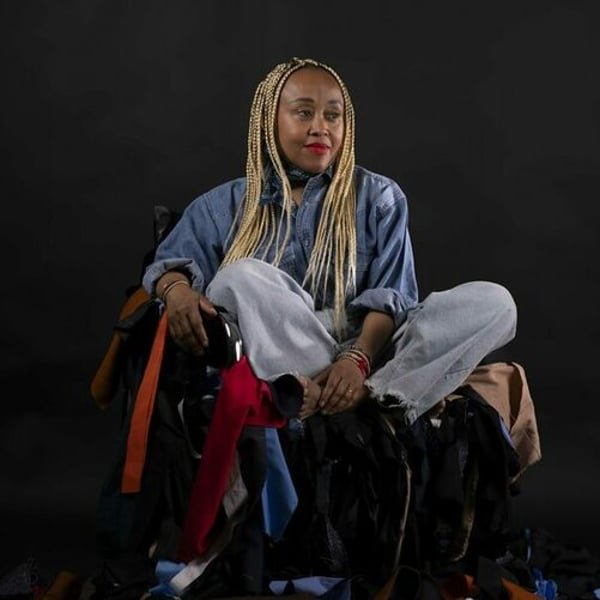
After three years of development, Sakina M’Sa will officially unveil her latest venture at the Carreau du Temple on Sunday, June 29. A pioneer of eco-conscious fashion in France, the designer is making a much-anticipated return to the runway with her new label, M/SA — short for Makers of Sustainable Aesthetics. The debut will present a gender-neutral luxury ready-to-wear line crafted from upcycled materials, aimed at multi-brand retailers and prospective buyers invited to the show.

The Franco-Comorian designer will present the Spring/Summer 2026 collection of M/SA. Titled “The Pure,” the line is a direct continuation of the sustainability-driven ethos M’Sa has championed throughout her career. A remarkable 80% of the materials used are sourced from deadstock luxury fabrics, unsold garments donated by brands unable to destroy them, and textile sorting centers across Europe. Each piece is crafted by employees of a social reintegration workshop housed in the Berlier manufacturing site in Paris’s 13th arrondissement.
But for Sakina M’Sa, sustainability is only part of the story — the greater challenge, she says, is aesthetic. “I’m one of the pioneers of sustainable fashion in France. But first and foremost, I went to fashion school. What matters to me is how desirable a product is — how it lives and what it embodies. All of that matters, of course, but ultimately, it should become the norm.”
Building scalable collections
With this new label, M’Sa aims to scale up sustainable and upcycled fashion. Unlike her earlier ventures, she now wants to meet real production demand for future stockists, marking a significant evolution in her production model. As the head of her eponymous brand, she was active on the official Paris Fashion Week calendar from 2001 to 2012, supported by the Fédération de la Haute Couture et de la Mode and its then-president Didier Grumbach.
In 2013, deeply shaken by the Rana Plaza disaster in Bangladesh, M’Sa visited the country and was struck by the chasm between her sustainable ideals and the harsh realities of local garment workers. The ecological arguments she advocated seemed distant from the daily urgency faced by women who needed to work, no matter the conditions.

Upon returning to France, M’Sa chose to step back from traditional fashion cycles, pausing collections and runway shows altogether. For years, she limited herself to designing just two pieces annually — a T-shirt and a sweatshirt — which she considers the most emblematic garments of our era. These pieces often featured politically charged messages.
Her eponymous brand was eventually acquired in 2015, and she gradually re-entered the creative space. In 2022, she partnered with Monoprix and La Redoute to design sustainable capsule collections, reigniting her interest in collaboration.
Connecting beauty with social impact
Today, M’Sa leaves her namesake label behind in favor of M/SA, a luxury project that reflects a new chapter. “What’s happening on Sunday is really the culmination of a realization I had two or three years ago. I told myself that now, we have to show — not lecture. If you’re an expert, your real talent lies in rolling up your sleeves and getting to work,” she says.
Beyond ethical sourcing and responsible production, M/SA also embodies M’Sa’s lifelong commitment to social justice through design. Since arriving in the Paris suburb of Bagnolet at 19, she’s championed fashion as a tool for empowerment. Through her project Décoller l’étiquette (Remove the Label), she’s led upcycling workshops for young people in Seine-Saint-Denis, using fashion to rebuild self-worth and social identity — a mission that continued even after she joined the official Paris calendar.
“One of the projects led us in 2007 to the Petit Palais for the exhibition L’Étoffe des Héroïnes, showcasing everything I’d accomplished with these young people,” she recalls.
Speaking the language of couture
“What has always fascinated me is connecting beauty to social causes — because these people are worth it,” says the designer. “I was worth it, too, when I left the housing projects without knowing anything about fashion. Like so many others, I came to Paris with nothing, but I believed I deserved beautiful things.”
One of her most widely covered social engagements was her decade-long work with the women’s prison at Fleury-Mérogis. In 2012, she staged a runway show for incarcerated women after one of them confided that she had always dreamed of becoming a model.

With M/SA, M’Sa continues her inclusive mission, creating opportunities for those with challenging life paths. Inside the Berlier factory, workers — surrounded by bolts of fabric, threads, and tools — bring their expertise to life. “Some of the newly arrived workers don’t speak fluent French,” she says. “But they sew exceptionally well because they were skilled mechanics or technicians back in their home countries. Sewing speaks for itself. Through it, we create jobs, beauty, and human worth — all in one place.”
Copyright © 2025 FashionNetwork.com All rights reserved.